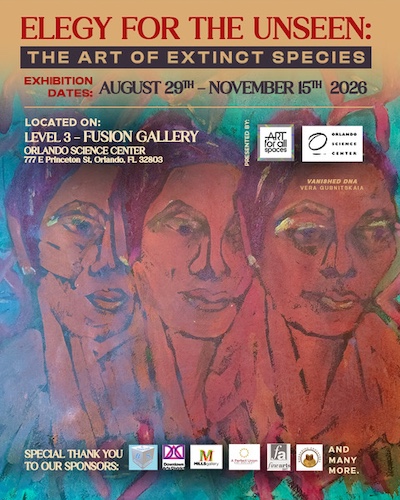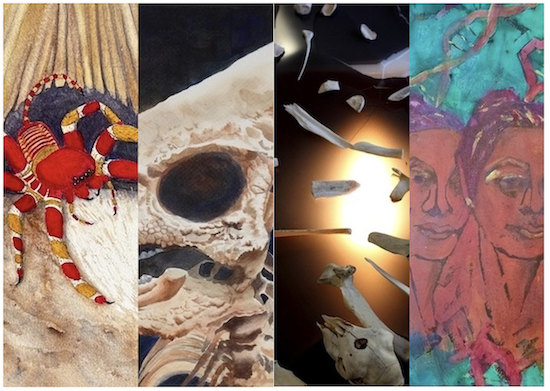
CFWS members Linda Brant, Vera Gubnitskaia, Teresa Chin, and Julie Nieves will be featured in the upcoming exhibit called “ELEGY FOR THE UNSEEN: The art of Extinct Species”, located in the Fusion Gallery at the Orlando Science Center. The show will be exhibited from August 28 through November 15, 2026 .
The exhibition spans approximately 600 million years of Earth’s biological history. Biologists estimate that more than 99% of all species that have ever lived are now extinct, representing over five billion species throughout Earth’s history.
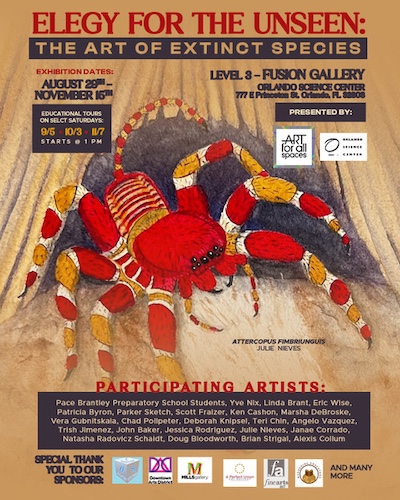
I chose attercopus fimbriunguis because of its mysterious placement in evolutionary history. Was it the ancestor of spiders or scorpions? It’s fascinating to consider what species lived and thrived or lived and died in comparison to the animals that are familiar to us today. It’s certainly going to be an exciting exhibition! Julie N.
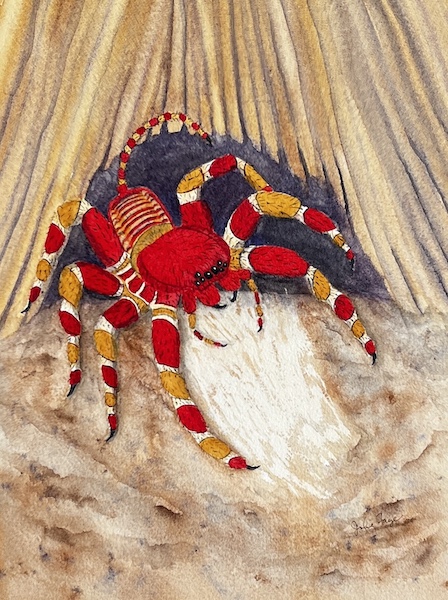
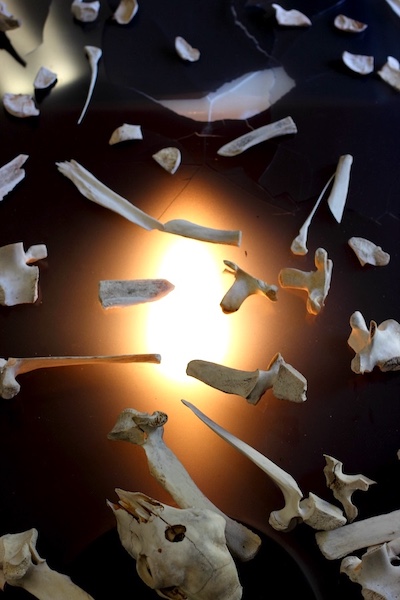
Resurrection biology, also known as de-extinction, is branch of science that seeks to create living proxies of extinct species using technologies such as ancient DNA analysis, genome editing, and back breeding. Ancient DNA is recovered by carefully drilling or grinding a small sample from exceptionally well-preserved bones or teeth. Researchers isolate the fragmented genetic material in specialized laboratories, then use advanced DNA sequencing techniques to reconstruct portions of the extinct animal’s genome. By comparing these ancient genetic sequences with those of modern species, scientists can better understand the evolutionary history of a particular species and identify key genetic traits of their wild ancestors. Science is actively exploring de-extinction research involving several iconic extinct species, including the woolly mammoth, dodo, Tasmanian tiger (thylacine), passenger pigeon, and aurochs. These efforts are expanding our understanding of genetics, evolution, and conservation biology, and may one day contribute to restoring lost ecological functions or strengthening the resilience of endangered living species.
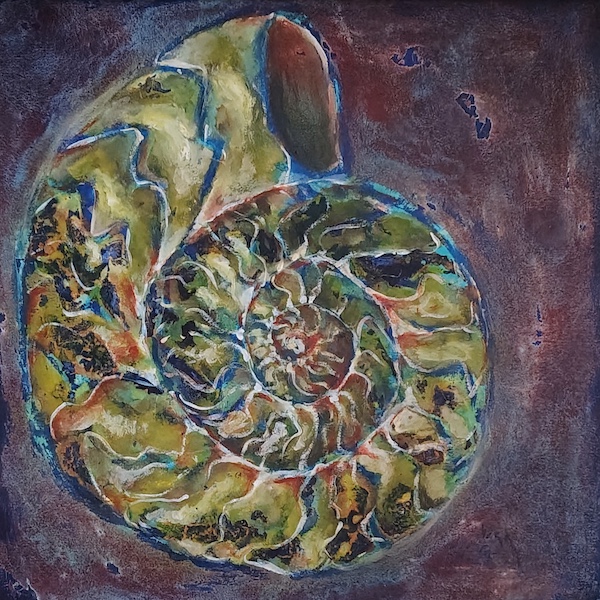
Ammonites were marine animals related to squid and octopus. They appeared on Earth about 410 million years ago. They had a spiral external shell divided into chambers and a soft internal body inside the shell. Their known size range was from 0.5” to over 7 feet in diameter. Ammonites fed on plankton, vegetation, and slow moving or dead marine animals. Ammonites went completely extinct about 66 million years ago.

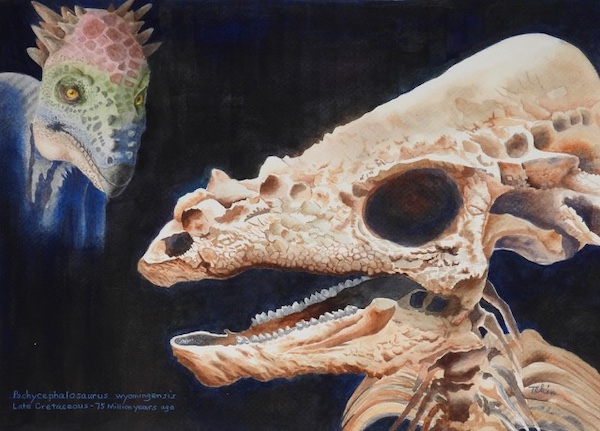
This 15 foot long dinosaur lived in western North America, was
a bipedal herbivore, known for its extremely thick domed skull, 11 inches in thickness, and bony knobs around the skull. It lived during the Late Cretaceous: 70-75 million years ago.
The head was supported by an S or U shaped neck, and
attached at the bottom of the skull. When it lowered its head to strike, it was perfectly aligned with its backbone to help absorb the impact. Tissue damage in several skulls resemble that of modern animals that head butt. Big eye sockets faced forward, so it had binocular vision. It had a muzzle with a beak and its teeth were tiny.
The dome surface was covered with tiny fibers, perhaps for brightly colored skin to put on a colorful display during breeding season to attract a mate.
Hope you can make it to this special exhibition of amazing art!